

Bug Note Episode 23: Why Adapt THAT Way?
Evolution is a fascinating, though sometimes strange, process. The vast diversity of living things is amazing, and odd structures of animals and plants can spark our curiosity, prompting us to wonder, “Why did they adapt that way?” On this episode of Bug Note, host Daniel Potter is joined by the entomologist leading the Natural History Museum of Utah, Jason Cryan. Together, they explore a few of the strange adaptations we see in the bug world and outline the benefits of adapting that way. Listen to the podcast here or scroll down to watch the video version.
Bug Note is now available wherever you get your podcasts.
| Listen on Spotify | Listen on Apple | Listen on Amazon | Listen on iHeartRadio |
Why did insects adapt to have six legs?
Jason: It's a great question. Other non-insect invertebrates have many more legs. So, think of centipedes with 100 legs (although it's not really 100), or millipedes with 1000 legs (not really 1000). It's all about the number of legs per segment of body. Those are multi-segmented animals. They don't have a lot of differentiation between body regions, and they have legs that come off each one of those segments in pairs or singly.
Insects, interestingly, have differentiation of body regions. They have a head, a three-segmented thorax, and a many-segmented abdomen. The thorax in insects is the center of locomotion. And that's an evolutionary strategy that was arrived upon in the ancestor of insects. And it worked. It worked really well.
Why did insects evolve to have wings?
Jason: Wings are particularly interesting because they allow the insect to disperse — to have a much wider range of activity than those who don't have wings. But there are all kinds of really interesting wing adaptations.
The primitive winged insects, dragonflies and damselflies, have these cool fixed wings that they can flap independently, which gives them great aeronautic ability. Other things, like beetles, that front set of wings have evolved mostly into hardened leathery shells. And that protects the flight wings — the hind wings – which are folded up underneath that shell.
What does survival of the fittest mean?
Jason: A successful species is one that survives into the next generation. Think about it from an individual point of view: You've likely heard the phrase “survival of the fittest.” Fitness from a biological standpoint is the ability of an individual to pass their genes along to the next generation. And so, the survival of the fittest doesn't necessarily mean that they can out-compete a competitor for food or something like that. It's their ability to out-compete the other animals of their kind to produce more offspring.
And so, any of these adaptations we're talking about, whether it's physical adaptations, color adaptations, behavioral adaptations, they're energetically costly, but they serve a purpose. And that purpose is to make sure that they have an advantage in passing their genes along to the next generation.
Bug Note on YouTube
Check out the extended conversation on YouTube. Be sure to like and subscribe to receive notice of upcoming episodes.
About Bug Note

Bug Note is hosted by Daniel Potter, a science writer who's also worked in the world of public radio for many years, and who loves fresh air and storytime. He's joined by Dr. Jason Cryan, NHMU’s Sarah B. George Executive Director and trained entomologist, and Christy Bills, NHMU's Invertebrate Collections Manager, as well as other bug-loving guests. Video production by Blank Space. The podcast is created in collaboration with the Natural History Museum of Utah, with the expertise and support of its scientific, philanthropic, marketing, and education teams. Special thanks to NHMU friend and insect enthusiast Ted Fridirici.
Authors
-

By Olivia Barney
Olivia serves as NHMU’s Marketing Copywriter/Coordinator, where she collaborates across departments to craft engaging stories that help bring groundbreaking research projects to life. She might be the Oxford comma’s number one fan.
-
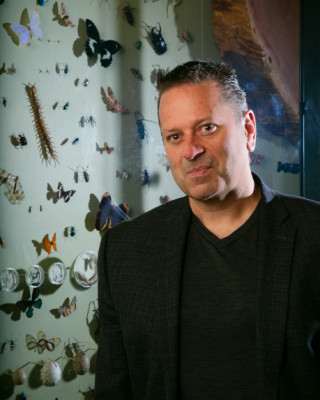
By Jason Cryan, Ph.D.
Areas of Expertise • Museum administration and leadership • Evolutionary biology • Entomology • Plant-feeding insects of the Order Hemiptera • Planthoppers, spittlebugs, treehoppers Background Jason Cryan, Ph.D., serves as the fourth executive director of the Natural History Museum of Utah. With its rich, 50-year history as the most important natural history museum in America’s...
-

By Dan Potter
Daniel Potter is a science writer and audio producer based in Nashville, Tennessee. He's reported for Nashville Public Radio and KQED in San Francisco, and has appeared on Science Friday and PBS NewsHour. He's also written for the Monterey Bay Aquarium. Some of his writing appears in the 2023 book Bay Curious: Exploring the Hidden True Stories of the San Francisco Bay Area.


