

Bug Note Episode 3: Let Me Count the Bugs
About Episode 3
If you’ve ever wondered how many species of insects live on the planet, or what the bug-to-human ratio is, this episode of Bug Note is for you. In this segment, host Daniel Potter explores bugs by the numbers alongside Jason Cryan, NHMU’s Sarah B. George Executive Director, and Christy Bills, NHMU's Invertebrate Collections Manager. Listen to the podcast here or scroll down to watch the video version.
Bug Note is now available wherever you get your podcasts.
| Listen on Spotify | Listen on Apple | Listen on Amazon | Listen on iHeartRadio |
The world of bugs is a massive and diverse place. In fact, it’s so massive that experts can’t definitively tell us how many species there are. The estimates vary widely — anywhere from one million to 30 million. Despite that large range, Cryan explains that “most scientists think there are probably between 2 and 5 million species.”
Still, only about a million of those species are known and named. “The vast majority of things out there,” continued Cryan, “are unnamed.” This is good news for bug enthusiasts, as it means that there’s still a lot to learn about and explore. After all, for every human on the planet, there are an estimated 1.5 billion insects alive at any given time (meaning that there are approximately a quadrillion insects living across the world).
To the average person, these numbers might sound astounding, but studies have revealed a significant decline in both insect diversity and population globally. Some suggest that the decline might be as high as 75% — which has Cryan and Bills concerned.
“Adults can probably anecdotally notice that there's less bugs than when they were children,” Bills says. To folks who resent swatting bugs at cookouts and on camping trips, that might sound like welcome news; but it’s a disconcerting reality, given the vital role bugs play for things like food and farming.
Most of us are familiar with the idea of insects acting as pollinators, which helps us grow the crops we eat. But their role is much larger than that. Bugs break down plants and other organic materials, often recycling essential nutrients back into the soil. They’re also the primary food source for other animals, including birds, lizards, and frogs — all of whom play their own important roles across ecosystems.
As insect populations decline, other systems and species face repercussions. And perhaps that’s the greatest lesson we can learn from this week’s episode: all living things rely on something else. Our lives are inextricably linked to the plants, animals, and bugs around us; so, when they thrive, we thrive too.
Bug Note on YouTube
Check out the extended version of Episode 3 on YouTube. Be sure to like and subscribe to receive notice of upcoming episodes.
About Bug Note

Bug Note is hosted by Daniel Potter, a science writer who's also worked in the world of public radio for many years, and who loves fresh air and storytime. He's joined by Dr. Jason Cryan, NHMU’s Sarah B. George Executive Director and trained entomologist, and Christy Bills, NHMU's Invertebrate Collections Manager, as well as other bug-loving guests. Video production by Blank Space. The podcast is created in collaboration with the Natural History Museum of Utah, with the expertise and support of its scientific, philanthropic, marketing, and education teams. Special thanks to NHMU friend and insect enthusiast Ted Fridirici.
Episode 3 at a Glance
Authors
-

By Olivia Barney
Olivia serves as NHMU’s Marketing Copywriter/Coordinator, where she collaborates across departments to craft engaging stories that help bring groundbreaking research projects to life. She might be the Oxford comma’s number one fan.
-
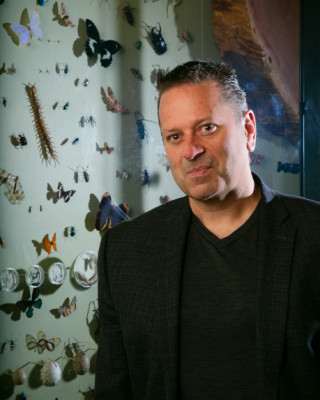
By Jason Cryan, Ph.D.
Areas of Expertise • Museum administration and leadership • Evolutionary biology • Entomology • Plant-feeding insects of the Order Hemiptera • Planthoppers, spittlebugs, treehoppers Background Jason Cryan, Ph.D., serves as the fourth executive director of the Natural History Museum of Utah. With its rich, 50-year history as the most important natural history museum in America’s...
-
By Christy Bills
Areas of Expertise • Insect collection curation • Science communication • Fireflies in the Western U.S. • Community Science Background Christy joined the Museum staff in 1998 and has been managing the invertebrate collections with the help of volunteers and interns ever since. Moving from 19th century technologies, she shepherded the collection from outdated housing to archival...
-

By Dan Potter
Daniel Potter is a science writer and audio producer based in Nashville, Tennessee. He's reported for Nashville Public Radio and KQED in San Francisco, and has appeared on Science Friday and PBS NewsHour. He's also written for the Monterey Bay Aquarium. Some of his writing appears in the 2023 book Bay Curious: Exploring the Hidden True Stories of the San Francisco Bay Area.


