

Exploring Dinosaurs From A to Z
By Olivia Barney
Utah is one of the best places in the world for paleontology, and new dinosaur discoveries are never far away! With so many exposed layers of fossil-bearing rock across the state, NHMU’s Paleontology Collections Manager, Carrie Levitt-Bussian, feels almost spoiled by all the excavation options. “What time period do we want to dig in today?” She asked in an episode of the Utah Unearthed podcast. “Do we want to dig in the Triassic? We can find really cool things in the Triassic Period. [Or] do we want to dig in the Jurassic? Cretaceous?”

Each of these geologic time periods feature many different species of dinosaurs over 165 million years, which helps us paint a bigger picture of the rise and fall of the dinosaur world during the Mesozoic Era. Some of these dinosaurs are recognizable icons you know and love, but others are lesser-known species that you may not have heard of before. In celebration of our deep dinosaur love, join us on an exploration of dinosaur species from A to Z.
Listing Amazing Dinosaurs From A to Z
Allosaurus fragilis
Age: Late Jurassic Period, ~150 million years old
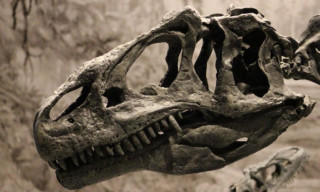
About Allosaurus fragilis:
Allosaurus is Utah’s state fossil, and more Allosaurus fossils have been found in Utah than anywhere else in the world! This abundance of specimens of this meat-eating dinosaur has given researchers a deeper understanding of the species and its lifestyle — something that isn’t possible with only one or two specimens.
Brachiosaurus altithorax

A digitally-painted side profile illustration of the sauropod dinosaur Brachiosaurus altithorax. This illustration incorporates reference material by Scott Hartman and Slate Weasel. Charles Nye
Age: Late Jurassic Period, ~150 million years old
About Brachiosaurus altithorax:
Brachiosaurus was a large sauropod (long-necked dinosaur) that fed on plants. It was larger in mass but shorter in length than its relatives Apatosaurus and Diplodocus. Though all three species lived during the same time and in the same area, Brachiosaurus was taller and better adapted to eating from tall trees, while Apatosaurus and Diplodocus typically ate vegetation lower to the ground.
Ceratosaurus nasicornis
Age: Late Jurassic Period, ~150 million years old
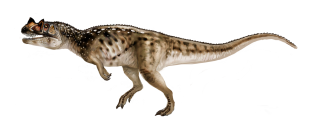
About Ceratosaurus nasicornis:
Ceratosaurus was one of the “big three” predators of the Late Jurassic Morrison Formation ecosystem, along with Allosaurus and Torvosaurus — though Ceratosaurus and Torvosaurus were much more rare than the abundant Allosaurus. Ceratosaurus features unique bony adornments above its eyes and along its nose, along with bony armor along the ridge of its back, which is rare among carnivorous dinosaurs.
Dystrophaeus viaemalae

Brian Engh
Age: Late Jurassic Period, ~156 million years old
About Dystrophaeus viaemalae:
Dystrophaeus may not be a household name, but it was the first sauropod dinosaur to be discovered in the American West, when John Strong Newberry found several bones while exploring the region south of Moab in 1859. The bones were preserved above a sheer cliff, so Newberry left most of the skeleton for a future paleontologist to excavate. The site was re-discovered in the 1980s, and NHMU excavated the rest of the skeleton between 2014 and 2025.
Eolambia caroljonesa

A restoration of Eolambia caroljonesa based on skeletal diagrams and fossils. Audrey.m.horn
Age: middle Cretaceous Period, ~100 million years old
About Eolambia caroljonesa:
Eolambia was a medium-sized herbivore (plant eater) related to Iguanodon and duck-billed dinosaurs that lived during the Early Cretaceous Period. No full skeletons have been found, but the specimen has been studied through nearly a dozen partial skeletons from both adult and juvenile specimens.
Falcarius utahensis
Age: Early Cretaceous Period, ~135 million years old
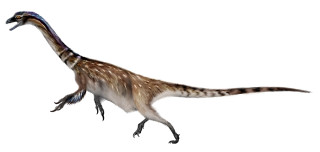
About Falcarius utahensis:
Falcarius means “sickle-cutter,” and this dinosaur was named for its sharp, curved claws! But those claws weren’t used for hunting. This remarkable dinosaur had meat-eating ancestors that evolved into plant eaters. It’s part of a group called therizinosaurs that also includes Utah native Nothronychus graffami. Nearly all therizinosaur fossils have been found in Asia, so paleontologists were surprised to find Falcarius and Nothronychus in Utah.
Gastonia burgei

Mariana Ruiz
Age: Early Cretaceous Period, ~120 million years old
About Gastonia burgei:
Gastonia was a type of armored dinosaur similar to Ankylosaurus, though it lacked a clubbed tail. Its armor protected it from predators like Utahraptor, which lived in the same region.

Hagryphus giganteus
Age: Late Cretaceous Period, ~76 million years old
About Hagryphus giganteus:
Hagryphus was a large, feathered dinosaur featuring a beak and a bony head crest. Only the hands and feet of Hagryphus have been found, so paleontologists have looked toward its close relatives Chirostenotes and Anzu to make inferences about its appearance and lifestyle.
Iguanacolossus fortis

Life restoration of Iguanacolossus fortis. Lukas Panzarin
Age: Early Cretaceous Period, ~135 million years old
About Iguanacolossus fortis:
A relative of Iguanodon from Europe, Iguanacolossus is only found in Utah. It grew to about 30 feet long, roughly the same size as the largest Iguanodon. It was described from a single, partial skeleton, which is cared for at the Natural History Museum of Utah.
Jeyawati rugoculus

© Lukas Panzarin / Utah Department of Natural Resources
Age: Late Cretaceous Period, ~90 million years old
About Jeyawati rugoculus:
Jeyawati rugoculus was described and named in 2010 after being discovered alongside Zuniceratops (see below) in western New Mexico. Like its relative Eolambia, it’s a type of early hadrosauroid, a plant-eating relative of duck-billed dinosaurs. Only one specimen has been discovered thus far.

Kosmoceratops richardsoni
Age: Late Cretaceous Period, ~76 million years old
About Kosmoceratops richardsoni:
Discovered in 2006, there are only three known Kosmoceratops specimens in the world — all of which are housed at the Natural History Museum of Utah. This relative of Triceratops is ornamented with 15 horns and spikes along its massive six-foot skull! This Cretaceous "bling" was likely for display, either to attract mates or recognize members of its own species, similar to how many living dinosaurs (birds) use their ornate feathers today.
Lythronax argestes

Lythronax on display at NHMU
Age: Late Cretaceous Period, ~80 million years old
About Lythronax argestes:
Lythronax is the oldest-known tyrannosaurid, the group that includes large-bodied tiny-armed tyrannosaurs such as the iconic Tyrannosaurus rex. The one and only known partial skeleton of Lythronax was excavated by NHMU paleontologists in 2009-2010.
Mierasaurus bobyoungi

Jason Abdale
Age: Early Cretaceous Period, ~135 million years old
About Mierasaurus bobyoungi:
Mierasaurus was a species of sauropod (long-necked dinosaur). The holotype specimen was found in Utah, within inches of Iguanacolossus. Mierasaurus is closely related to Moabosaurus, another sauropod found in Utah, but most of its relatives are from the Late Jurassic of Europe.
Nasutoceratops titusi
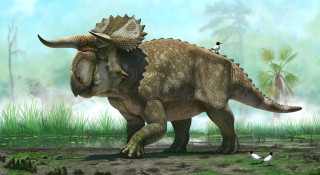
Age: Late Cretaceous Period, ~76 million years old
About Nasutoceratops titusi:
Nasutoceratops is another remarkable relative of Triceratops. Though it has far fewer horns than Kosmoceratops, the horns above the eyes remind one of Texas longhorn cattle. This, along with its oversize nose, mean its name, which translates to “big nose horn face,” is quite fitting.
Oryctodromeus cubicularis

Oryctodromeus is a basal ornithischian dinosaur that lived in the Late Cretaceous of what is now North America. It was a small, fast running herbivore, and the first non-avian dinosaur discovered with direct evidence of burrowing behavior. TotalDino
Age: middle Cretaceous Period, ~100 million years old
About Oryctodromeus cubicularis:
Oryctodromeus was a small, quick moving plant-eater that sometimes lived in underground burrows. It’s been found in parts of Montana and Idaho, earning it the honor of Idaho’s state dinosaur in 2023.
Parasaurolophus cyrtocristatus
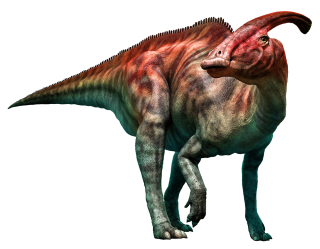
Age: Late Cretaceous Period, ~75 million years old
About Parasaurolophus cyrtocristatus:
Parasaurolophus was a duck-billed dinosaur that featured a long, distinctive bony but hollow crest extending from the back of its skull. The largest number of Parasaurolophus fossils have been discovered from Utah, so the species is a favorite for Tylor Birthisel, a member of NHMU’s paleontology team.
Qianlong shouhu

Mani Paleologi
Age: Early Jurassic Period, ~195 million years old
About Qianlong shouhu:
Based on only three partial skeletons and a few leathery eggs, Qianlong is an early sauropodomorph, meaning it is a close relative of the iconic long-necked titans called sauropods (like Brachiosaurus). While it still has a long neck and tail, it also walked on two legs and featured clawed hands.
Riojasaurus incertus

Wikimedia Commons
Age: Late Triassic Period, ~215 million years old
About Riojasaurus incertus:
An even earlier sauropod relative than Qianlong, Riojasaurus lived during the Late Triassic Period, making it the oldest dinosaur on this list! Two specimens of Riojasaurus have been found in La Rioja Province in Argentina, its namesake. It grew to approximately 22 feet long.
Seitaad ruessi
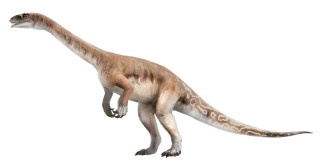
Age: Early Jurassic Period, ~180 million years old
About Seitaad ruessi:
Seitaad walked across desert sand dunes in what is now Utah. Like Qianlong and Riojasaurus, Seitaad was an early relative of the hulking long necks you might be familiar with. It did have an elongated neck and tail — but only measured about ten feet in total length. The only known skeleton of Seitaad is on exhibit at NHMU and was discovered by the late Utah artist Joe Pachak.
Teratophoneus curriei

Fito Torres / NHMU
Age: Late Cretaceous Period, ~76 million years old
About Teratophoneus curriei:
Teratophoneus, whose name translates to “monstrous murderer,” was a fierce predator that roamed during the Late Cretaceous Period in what is now Grand Staircase-Escalante National Monument in southern Utah. This species is a tyrannosaurid closely related to Lythronax and Tyrannosaurus rex.
Utahraptor ostrommaysi
Age: Early Cretaceous Period, ~125 million years old
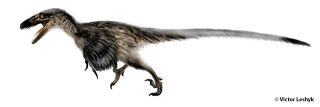
About Utahraptor ostrommaysi:
Utahraptor was a fearsome predator of the Early Cretaceous Period that featured claws that were nearly ten inches long! It’s Utah’s state dinosaur — its name literally means “Utah’s predator” — and it was the inspiration for the size of Velociraptor in the film Jurassic Park! Though Velicoraptor was much smaller than in the films, Utahraptor, however, was big; adults were around 20 feet (6.1 meters) long and around 5 feet (1.5 meters) tall at the hip.
Venenosaurus dicrocei

Fran84sco44
Age: Early Cretaceous Period, ~120 million years old
About Venenosaurus dicrocei:
Among all the sauropod titans, Venenosaurus is relatively small, measuring “only” about 39 feet long from head to tail. It was first discovered in 1998 by Denver Museum of Nature and Science volunteer Anthony DiCroce, so the species is named after him.
Wuerhosaurus homheni

Connor Ashbridge
Age: Early Cretaceous Period, ~130 million years old
About Wuerhosaurus homheni:
Discovered in China in 1973, Wuerhosaurus is a type of stegosaur from the Early Cretaceous Period. Like Stegosaurus, Wuerhosaurus also had broad bony plates sticking up from its neck, back, and base of tail, with sharp spikes toward the end of its tail to ward off predators. It is one of the last stegosaurs in the fossil record, demonstrating that they survived past the end of the Jurassic Period.
Xenoceratops foremostensis

Reconstruction of Xenoceratops foremostensis in its environment ABelov2014
Age: Late Cretaceous Period, ~78 million years old
About Xenoceratops foremostensis:
Xenoceratops was found near Foremost, Alberta, Canada. Like Diabloceratops and Machairoceratops from Utah, it had large spikes projecting from its frill. All three of these horned dinosaurs, along with Nasutoceratops also from Utah, belong to a group called Centrosaurinae.
Yutyrannus huali
Age: Early Cretaceous Period, ~125 million years old
About Yutyrannus huali:

Yutyrannus huali reconstruction based on the golden pheasant (Chrysolophus pictus) Alopesc
Yutyrannus was a large carnivorous predator that roamed what is now China. Unlike the tyrannosaurids such as Lythronax and Teratophoneus that would come later, Yutyrannus is an early tyrannosaur that had three fingers on each hand and longer arms. It also sported two small horn-like projections near its eyes. Yutyrannus is the largest dinosaur that we’re certain had feathers, because they were found fossilized along with the skeleton.

Fito Torres / NHMU
Zuniceratops christopheri
Age: Late Cretaceous Period, ~90 million years old
About Zuniceratops christopheri:
Zuniceratops was a small ceratopsian. It was discovered in New Mexico by eight-year-old Christopher James Wolfe in 1996. While it grew to 7-11 feet long and 3.5 feet tall at the hips, it was quite small when compared with later horned dinosaurs. Zuniceratops is important for our understanding of ceratopsian evolution, displaying a transition between earlier small ceratopsians without horns, and the larger, more ornate ceratopsians, such as Kosmoceratops, Nasutoceratops, and Triceratops that came later.

Want more dinos?
See many of these dinosaurs for yourself by visiting the Past Worlds exhibition at NHMU. For even more dinosaur content, join us at DinoFest in January!
Authors
-

By Olivia Barney
Olivia serves as NHMU’s Marketing Copywriter/Coordinator, where she collaborates across departments to craft engaging stories that help bring groundbreaking research projects to life. She might be the Oxford comma’s number one fan.
-
By Randall Irmis, Ph.D.
Joining the Museum staff in January 2009, Randall Irmis received his PhD in Integrative Biology in December of 2008 from the University of California, Berkeley. In 2004, he received an Extended B.S. in Geology with an Emphasis in Paleontology, graduating Magna Cum Laude from Northern Arizona University. Irmis' research asks how vertebrate animals living on land evolved through deep...


