

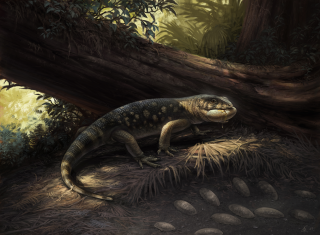
Kaprosuchus, Late Cretacious, semiaquatic Keegan Melstrom
Top Science Stories of 2025
By Olivia Barney
The scientific world is always in motion, with new discoveries being made each year! In 2025, we noted the discovery of previously unknown species, a breakthrough in the realm of black hole science, and a shocking example of rapid evolution in action. Though there were hundreds of fascinating discoveries made throughout the year, here are six of the top science stories of 2025 to get you started.
New Monstersaur Species Honors Tolkien
Artistic reconstruction of Bolg amondol, depicted raiding an oviraptorosaur dinosaur nest amidst the lush Kaiparowits Formation habitat. Art by Cullen Townsend
A new giant lizard species was discovered and named after one of Tolkien’s most fearsome characters from “The Hobbit.” Meet Bolg amondol, a monstersaur that lived alongside the dinosaurs of the Late Cretaceous Period.
This large, bulky lizard was found in Grand Staircase-Escalante National Monument in Utah and is thought to be faunivorous (animal-eating). It lived alongside two other faunivorous lizards, in addition to a plethora of dinosaurs and crocodyliforms, in what is now the Kaiparowits Formation. While the discovery of an ancient lizard might not sound like groundbreaking news, it changes how paleontologists are understanding the dynamics and evolution of the greater monstersaur family. Additionally, the presence of so many predators co-existing in one location suggests that the Kaiparowits Formation was once a thriving and stable ecosystem.
Evidence Suggests Sharks Enjoy Playtime
A growing body of research into the intelligence of animals has led zoos and aviaries to offer environmental enrichment opportunities for the animals under their care. These enrichments include toys and puzzles, providing the animals both mental stimulation and entertainment.
This is not yet standard practice in aquariums, however, as fish have traditionally been viewed as less intelligent. However, recently researchers at a Southern California aquarium began challenging this belief, adding dive rings and plastic pool toys to their tanks. At first, the sharks, skates, and rays ignored the objects, but after a couple of weeks, they became curious. Now, video footage shows the California skate playing with an orange ring and a young leopard shark playing with a plastic squid — and ongoing research shows that each animal in the tank shows a preference for certain colors and objects.
California Hummingbirds Evolving Rapidly

Backyard birding is becoming ever more popular, with more homeowners setting up cameras, feeders, and bird houses across their property. This fun and accessible hobby helps people develop a love and appreciation for the diversity of wildlife near their homes, but it’s also changing the way some of these species are evolving.
Across the western United States, the Anna’s hummingbird is one example of rapid evolution in action. Thanks to the prominence of hummingbird feeders across California, the Anna’s hummingbird has been able to expand its range outside of Southern California. More shockingly, the birds themselves have changed in just a few generations, including a dramatic change in the size and shapes of their beaks.
Black Holes Twist Spacetime
Black holes are intriguing and mysterious, partially due to how difficult they are to study. Over the years, many theories about the nature and behavior of black holes have emerged, including a theory about how black holes disrupt surrounding matter, warping spacetime itself. This theory, originally posited by Einstein in 1913, has finally been proven thanks to a rare astronomical event.
The National Astronomical Observatories at the Chinese Academy of Sciences, with support from Cardiff University, studied the death of a star, watching as it was ripped apart by a supermassive black hole. After the star’s destruction, its remaining material formed a spinning disk around the black hole. These events were measured through x-ray and radio signals, allowing researchers to investigate black hole spin.
New Fossil Face Helps Us Rethink Human Origins
An international team of researchers recently unveiled a digital reconstruction of a 1.5-million-year-old fossil of a human face, and it didn’t look the way they expected. The brain case is consistent with other Homo erectus fossils, but the face and teeth of this specimen are far more primitive than typical — resembling much older human ancestors.
The finding is challenging long-held beliefs about human evolution and hinting at a far more complex web of migrations than previously thought. The discovery also suggests possible mixing between early human species. Now, researchers are working to compare this facial reconstruction to other early hominins to see if they can discover additional clues about early human life.
Crocodiles Hold Secrets of Survival

Randy Irmis faces off with a fossil Borealosuchus skull from the Natural History Museum of Utah’s collections. This crocodylian lived approximately 48 million years ago in the American West. Jack Rodgers / NHMU
Extinction is inevitable for all species, but the timeline of that ending depends on how the animal adapts to the challenges that come its way. As available resources and environmental conditions change, species will either be forced to adapt and evolve or face its extinction — like the prehistoric dinosaurs or Ice Age megafauna. There’s no one-size-fits-all adaptation that ensures a species longevity, but new research has revealed key characteristics that make survival more likely.
Often perceived as “modern dinosaurs,” crocodiles, alligators, and caimans belong to a resilient group called crocodylomorphs — a category that also includes many of their extinct relatives. Crocodylomorphs have survived at least two mass extinction events, leading researchers to investigate what the crocs are doing “right.” So far, they’ve discovered a few key attributes relating to diet and adaptability that may point to the secret of long-term survival.

Want more science stories?
Subscribe to our Research & Science email list to hear about the cool scientific research happening year-round at NHMU!
Authors
-

By Olivia Barney
Olivia serves as NHMU’s Marketing Copywriter/Coordinator, where she collaborates across departments to craft engaging stories that help bring groundbreaking research projects to life. She might be the Oxford comma’s number one fan.


